Loading
Engineering
Disciplined refinement, documented honestly.
CORVO publishes its engineering reasoning, including the targets that were revised when the math disagreed with ambition. Credibility comes from detail, not hype.
 CONCEPT V0.1
01 · Starting Point
Designing from the point of contact
Most automotive products are designed from the outside in: how they photograph, then how they install, then, eventually, how they feel. CORVO works in the opposite order. The shift knob is touched hundreds of times per drive, almost always without looking, so the hand is the first customer and the camera is the last.
That priority shows up as constraints. The Rev A surface strategy bans knurling, finger grooves, and decorative facets. That is not minimalism for its own sake; every tactile break must earn its place. The form supports four distinct grips: palm shifting, fingertip control, side grip during spirited driving, and the reverse and parking grip. Curvature is held to G2 continuity where possible, G1 tangency at minimum, so nothing catches the skin mid-shift.
02 · Mass
Mass as a functional material
- Rejected target
- ~250 g
- Revised target band
- 205–220 g
- Current calculated
- 214 g
A shift knob's mass changes the shift itself: it smooths lever motion, damps gate notchiness, and gives the hand something honest to push against. So CORVO treats mass as a specified engineering property, not a bragging number.
That discipline was tested early. The original aluminum target of roughly 250 grams turned out to be mathematically unreachable inside the approved envelope. Aluminum simply isn't dense enough at this volume. Instead of keeping an aspirational number the part could never meet, the target was formally revised to 205–220 g. The current assembly calculates to 214 g. Buyers who want more mass will be served by denser materials, not by inflated specifications.
03 · Balance
Neutral-to-low balance
- Approved band
- 40–48 % below midplane
- Current calculated
- 41.9 %
- Assembly CoG
- Z 32.4 mm
Where the mass sits matters more than how much there is. A top-heavy knob feels vague at the top of the throw; an excessively bottom-heavy one feels dead. CORVO-001 targets a neutral-to-low balance: 40–48 % of assembly mass below the geometric midplane.
This band, too, replaced an earlier ambition. A 55–60% below-midplane figure was explored and rejected. The approved exterior geometry cannot deliver it without hollowing the crown into something that feels cheap. The assembly lands at 41.9% below midplane with its center of gravity at Z 32.4 mm, effectively sitting on the Z 32.0 mm midplane. The steel adapter, seated low in the base with its own center of gravity around Z 6 mm, is what makes even that possible in aluminum.
04 · Compatibility
Modular vehicle compatibility
- Retention
- Two mechanical joints
- Adhesive in load path
- None
- Status
- Provisional
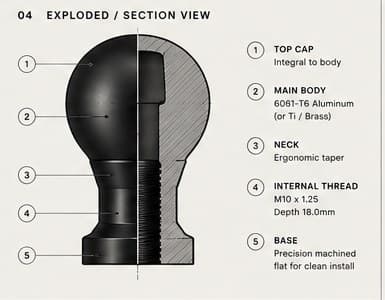
CORVO-001 is deliberately not locked to one car. The Mazda MX-5 Miata is the development platform, a car whose shifter rewards exactly this kind of attention. But vehicle-specific threads live in a replaceable steel adapter, not in the knob body. Supporting another platform means machining another adapter, not redesigning the knob.
How that adapter is held was the program's longest-running open question, and the requirement was written in performance terms rather than mechanisms: mechanically secure, resistant to rotational slip and vibration loosening, durable under repeated installation, serviceable with ordinary care, and never reliant on adhesive as its only retention. Earlier concepts were rolled back rather than approved because they could not meet all of it at once.
The resolved architecture separates the two loads. One joint resists rotation; a second, entering from below, resists pull-out. Both are mechanical and positive, and neither carries adhesive. Releasing the adapter for a swap is a single-fastener job. The sizing behind it is first-order estimation, which is enough to choose the architecture and not enough to call it proven. It stays provisional until hardware says otherwise.
05 · Longevity
Serviceable construction
An object meant to last longer than its first car has to come apart. The adapter system exists so a thread interface can be swapped when the owner changes platforms, and so a worn component can be replaced instead of scrapping the body.
Serviceability is also why the attachment system is required to be boring. Cleverness that can't be repeated in a home garage ten years from now is a liability, not a feature. That is most of the argument for standard, ordinary hardware over anything more inventive. The service procedure is one fastener.
06 · Discipline
Geometry refinement and revision control
- Prototype revision
- Rev A
- Drawing revision
- Rev C
- Exterior
- Provisional locked
The exterior profile is labeled REV A PROVISIONAL LOCKED PROFILE. Locked means the geometry only changes in response to evidence: physical testing, manufacturability review, or safety review. Never taste drift. Provisional means the program is honest that a first physical prototype may produce that evidence.
Physical revisions and drawing revisions are tracked as separate systems: the prototype revision changes only when the machined part changes, and the drawing revision changes only when documentation changes. It's a small discipline that prevents a familiar failure mode: paperwork pretending to be progress.
The same discipline decided the internal bore: when the first size left too little wall in the neck, the bore gave way rather than the wall or the locked exterior. And it is why the drawing revision has advanced more than once while the prototype revision has stayed put. The documentation changed, no revised part has yet been accepted, and the two facts are recorded separately.
07 · Materials
Material-specific engineering
One geometry, three densities. Each material variant needs its own internal strategy to stay inside the same mass-balance philosophy. Aluminum needs the steel insert's ballast to reach the balance band at all. Titanium's cavity study showed the internal access channel costing roughly three percentage points of balance. Tightening it to Ø8 mm brings the variant back inside the band at a calculated ~312 g. Brass inverts the problem entirely: at a targeted 440–480 g, the engineering task is removing material, with early analysis suggesting on the order of 16.5 cm³ of internal relief.
None of these figures are production claims. They are the current state of a digital model that the first physical parts will confirm or correct, and either result is useful.
Early Access
Watch the engineering happen.
Build-log entries document decisions, revisions, and open questions as the program moves toward hardware.